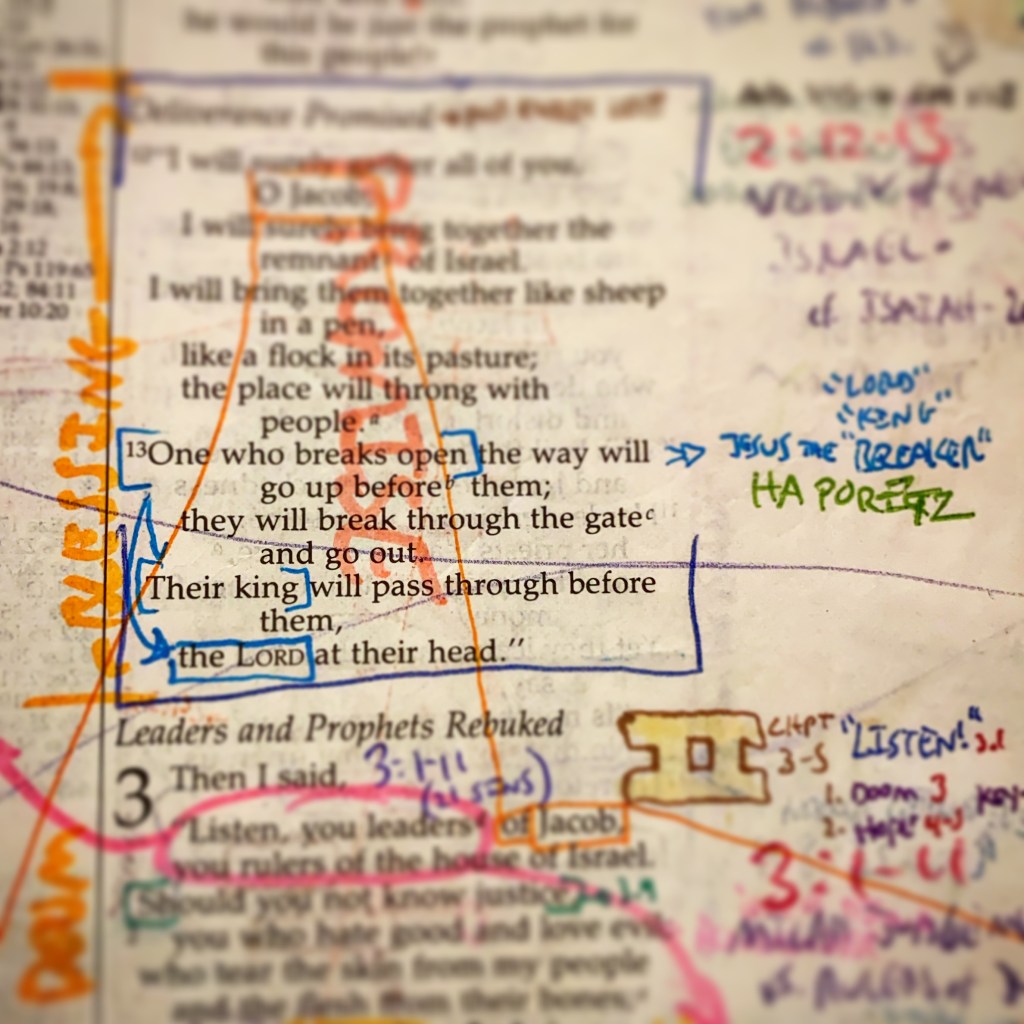
Jesus the Breaker

[One who breaks open] the way will go up before them;
they will break through the gate and go out.
[Their King] will pass through before them,
[the Lord] at their head.
~Micah 2:13

The more famous of the Christmas prophecies about Jesus comes in chapter 5, “But you, O Bethlehem Ephratha… out of you will come for me, one who will be ruler over Israel.” But in this prophecy, that Ruler, Jesus is [the one who breaks open] the way… the King… the Lord. When he comes and sets his people free, nothing can hold them back. Following our King brings freedom. 

Let every heart prepare him room.

Divine Rest

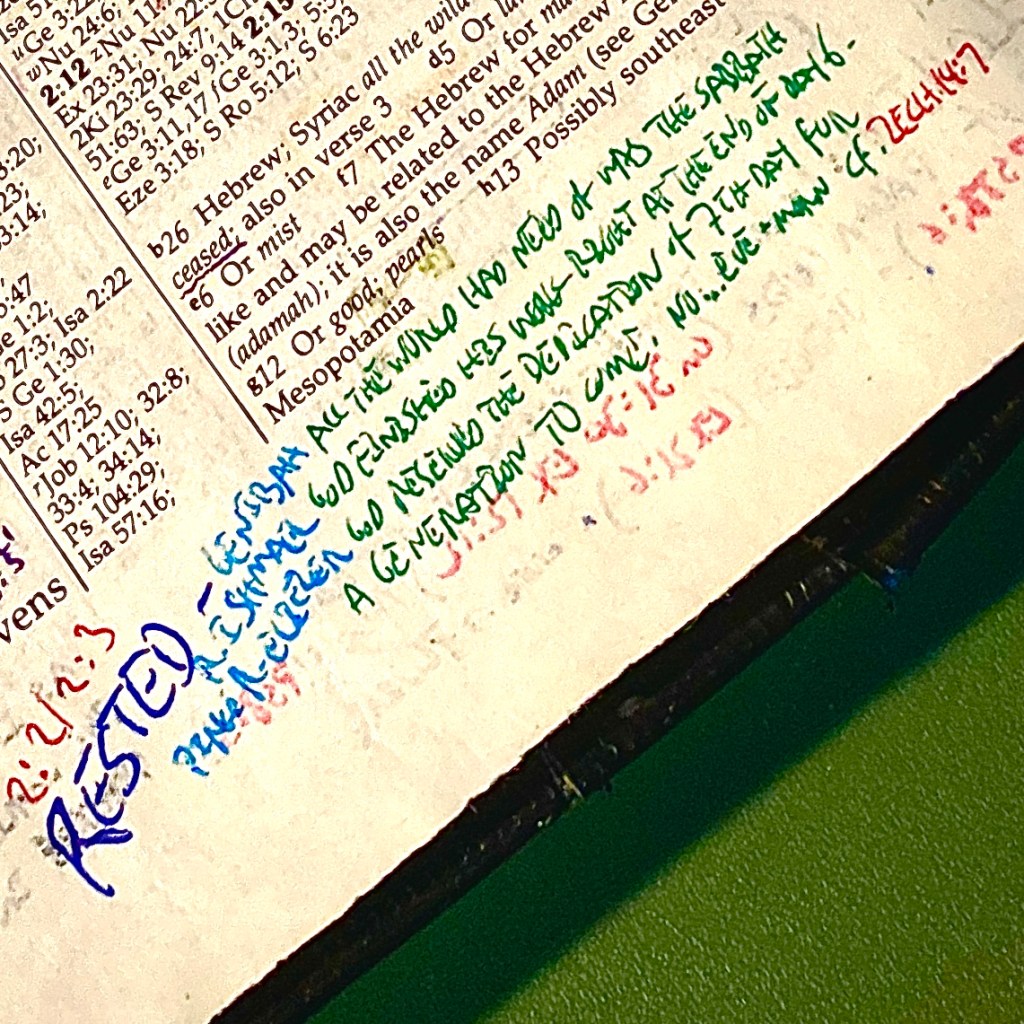
Genesis 2 begins with, of course, day seven of creation—the day on which God “rests” or “ceases his work”. It reads:

Thus the heavens and the earth were completed in all their vast array. By the seventh day God had finished the work he had been doing; so on the seventh day he rested from all his work. And God blessed the seventh day and made it holy, because on it he rested from all the work of creating that he had done. ~Genesis 2:1-3

Amid all the various scratchings next to Genesis 2 in my bible there is a note which references a Rabbi Genibah who lived around 300 A.D. At the risk of repeating an opinion formed 1,600 years after Genesis 2 was written, I’d like to share it with you:

Continue reading “Divine Rest”

A Good Day: New Day, New Creation

Mark 16:1-6 When the Sabbath was over, Mary Magdalene, Mary the mother of James, and Salome bought spices so that they might go to anoint Jesus’ body. Very early on the first day of the week, just after sunrise, they were on their way to the tomb and they asked each other, “Who will roll the stone away from the entrance of the tomb?”

Many of you have seen how I have marked up the study Bible I’ve used since college and I’d like to share with you one of it’s pages.

I believe Mark was the first gospel written. I believe Matthew, Luke and John knew of Mark and used Mark’s gospel as a pattern or template for how they told the story of Jesus. This is what I have noted in my bible:
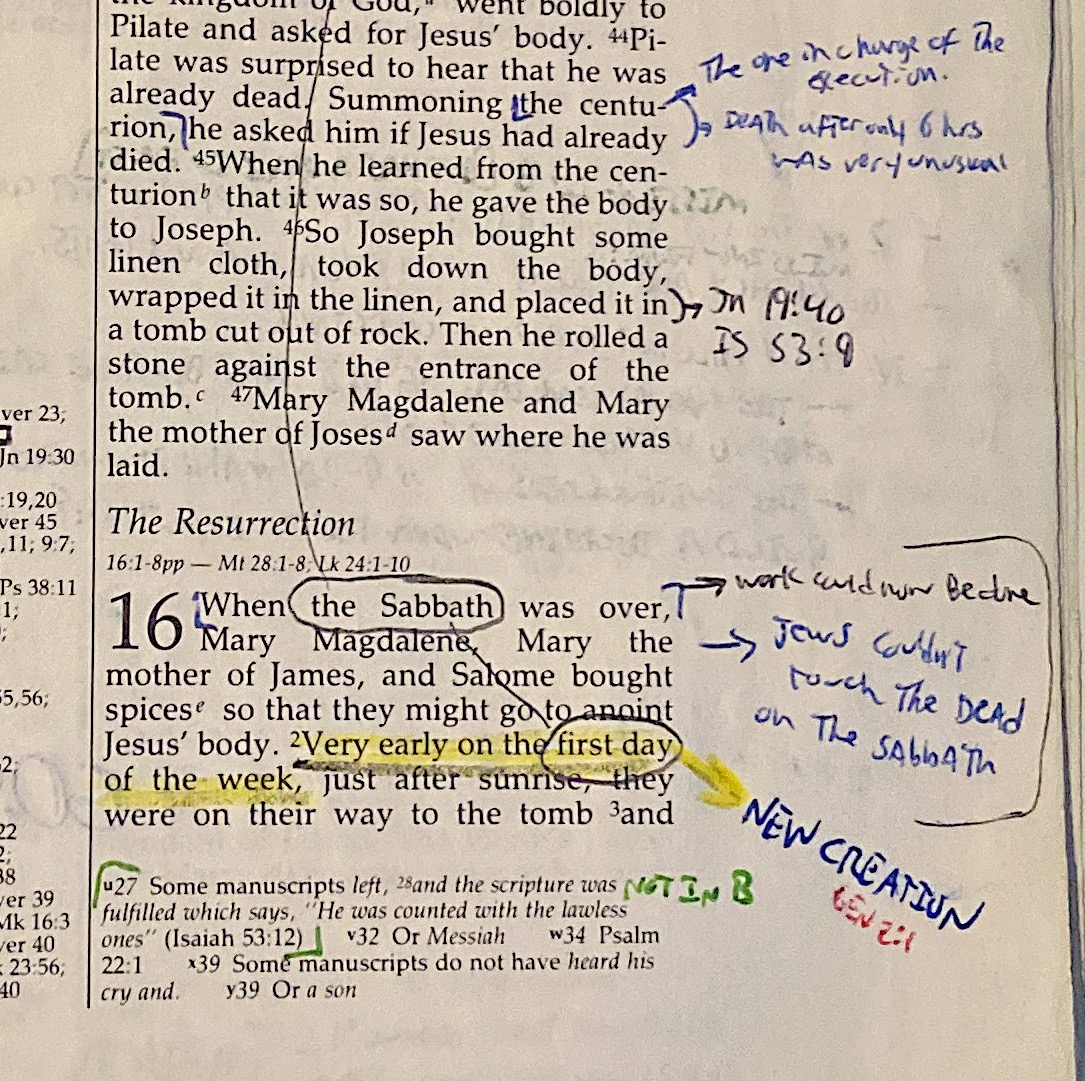
C71DC5C1-355E-4134-A36D-BBE29B78FB74.JPG

On Easter Sunday, I was reminded of something I hadn’t noticed before. Pastor Levi Lusko as Fresh Life church in Montana said this:

On the seventh day God created rest. That day seven rest was the final act of creation. God gave us rest on day seven to delight in what he had done. Now that original week was spoiled by sin which is why there is Covid19 in the world. Which is why there’s diseases and pain and cancer—because under the first Adam’s headship we who had control of this world took things in a very dark direction and chose to worship things as God instead of God as God.

 Jesus came he came to do what the first Adam failed to do. In rising from the dead he proved he is capable of leading this planet in a way that honors God. That’s why it was in the garden [of Gethsemane] he chose not to do his will but to take up the cup and do what his Father had called him to do. That’s why when he died he chose to die and come back to life from death on the First Day of the Week—showing there is a man at the helm of the universe. A man who will honor his Father and lead us into a New Week. His action of rising was the beginning of a brand new week that will have no end, that will never be spoiled, that eventually ultimately will consummate in a brand new world.

All of the gospel writers picked up on the fact Mark reminds us of: Easter occurred on the first day of the week. They all say “early in the morning, on the first day of the week.” [Matthew 28:1, Luke 24:1, John 20:1] Jesus could have picked any day he wanted, but he intentionally chose to rise on the first day of the week. He had been planning this since… well, since forever. The day Jesus rose was the beginning of a brand new day [early in the morning], a brand new week [on the first day of the week], and a brand new era:

If anyone is in Christ, the new creation has come: The old has gone, the new is here! ~2 Corinthians 5:17

The old original week of creation has been put aside with its Sabbath rules and regulations and laws, something new has begun!

If you are in Christ you are a New Creation. You live in a Creation being made New. You bring Newness wherever you go. The New Creation is always on your horizon. Two things come to mind. (1) Rejoice in this truth, in spite of any personal trial all who are in Christ are a New Creation and your home is in heaven. (2) Remove everything linked to your old creation. Your newly minted self is marked by holiness. Shake off the rust. (3) Remember, Jesus does not leave us as orphans. You have the Holy Spirit’s strength and help to remind you of his words:

Do not let your hearts be troubled. You believe in God; believe also in me. My Father’s house has many rooms; if that were not so, would I have told you that I am going there to prepare a place for you? And if I go and prepare a place for you, I will come back and take you to be with me that you also may be where I am. ~John 14:1-3

May this bring you hope!

Hope will give you the power to embrace what you previously wished to escape. ~Levi Lusko

chosen one

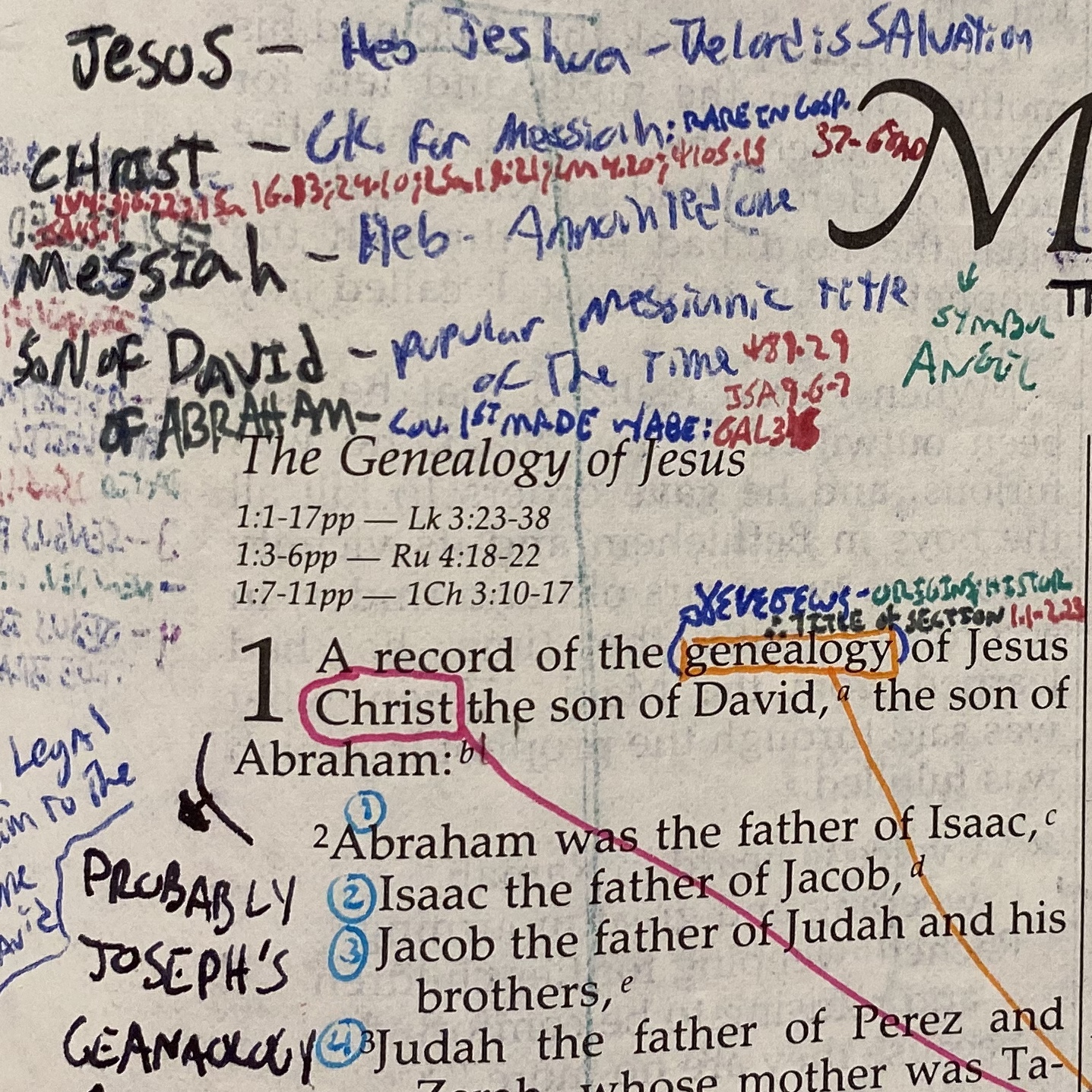
Lots of titles in Matthew’s first words: Jesus, Christ/Messiah, Son of David, Son of Abraham.

Jesus is “Joshua” meaning “the Lord is salvation.

Christ is Greek for Messiah which, in turn, is Hebrew for “anointed one”

Son of David was a popular title for the messiah at the time

Son of Abraham is a reminder of the first covenant made with the father of the Hebrew people.

opening mark

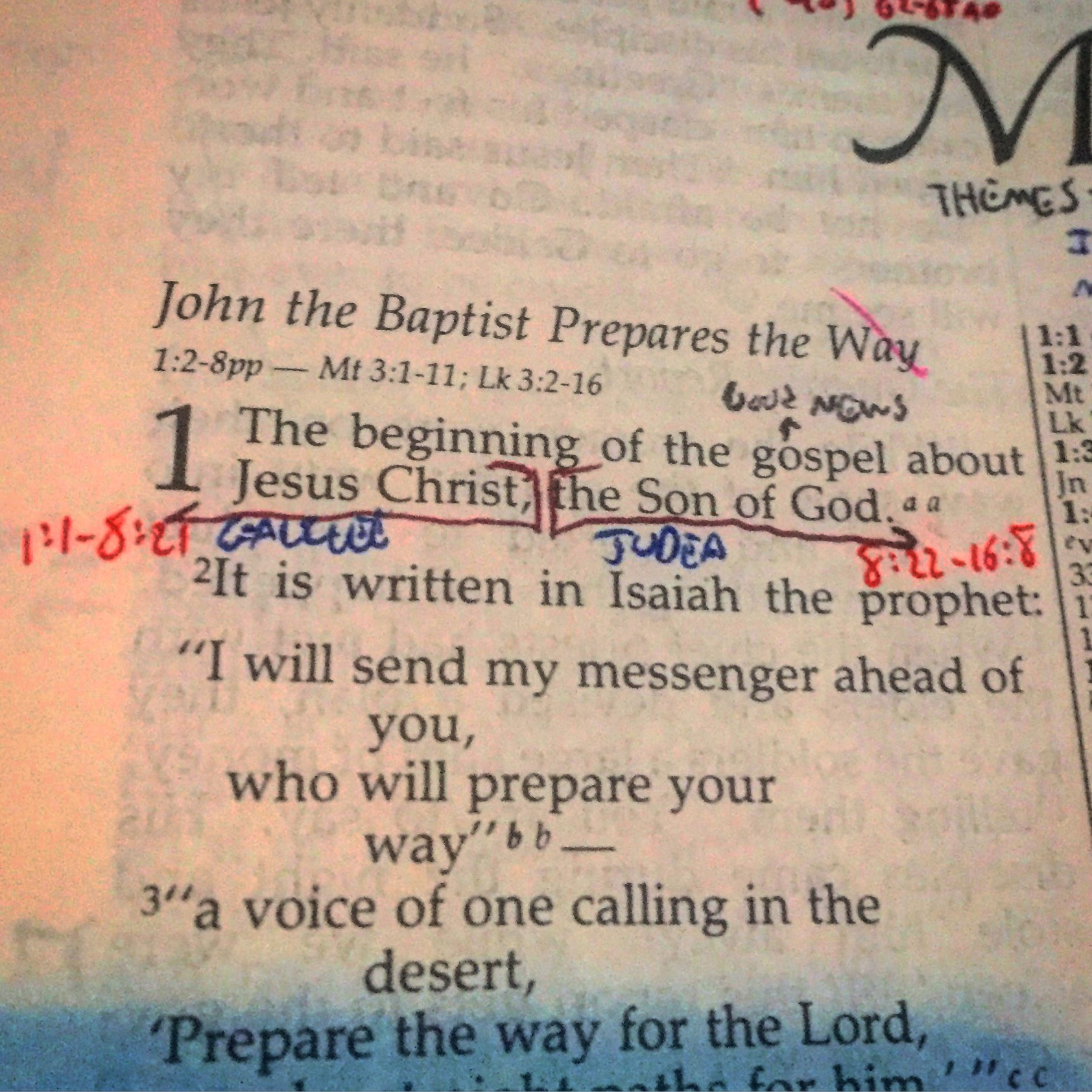
IMG_1852↼Jesus Christ]
[the Son of God⇀

We take gospels for granted. They’re everywhere available. Every hotel has one in its nightstand. Yet Mark has done something unique. Never before has there been a piece of literature like this written before. When Mark was written, the literary form of gospel hadn’t been invented. No one had ever written an extended crucifixion story before, and certainly not used a crucifixion story to make the case that Jesus Christ was the Son of God. This was completely new.

He’s not making this up from scratch, of course. He borrows the parts he likes from the genre of ancient biography. He has a lot of Hebrew narrative on his mind: quoting the prophets Micah (1:2) and Isaiah (1:3), subtle references to Joshua crossing the Jordan (1:9), Noah’s dove (1:10), the Exodus (1:11, cf. Exodus 4:22-23), the ever-present wilderness (1:12). Throughout his introduction Mark draws on the long history of the people of God but he makes his case, he tells us what he wants to accomplish with this work in his first few words: this biography-gospel is going to show that (1) Jesus is the Christ and (2) the Son of God.

shared work

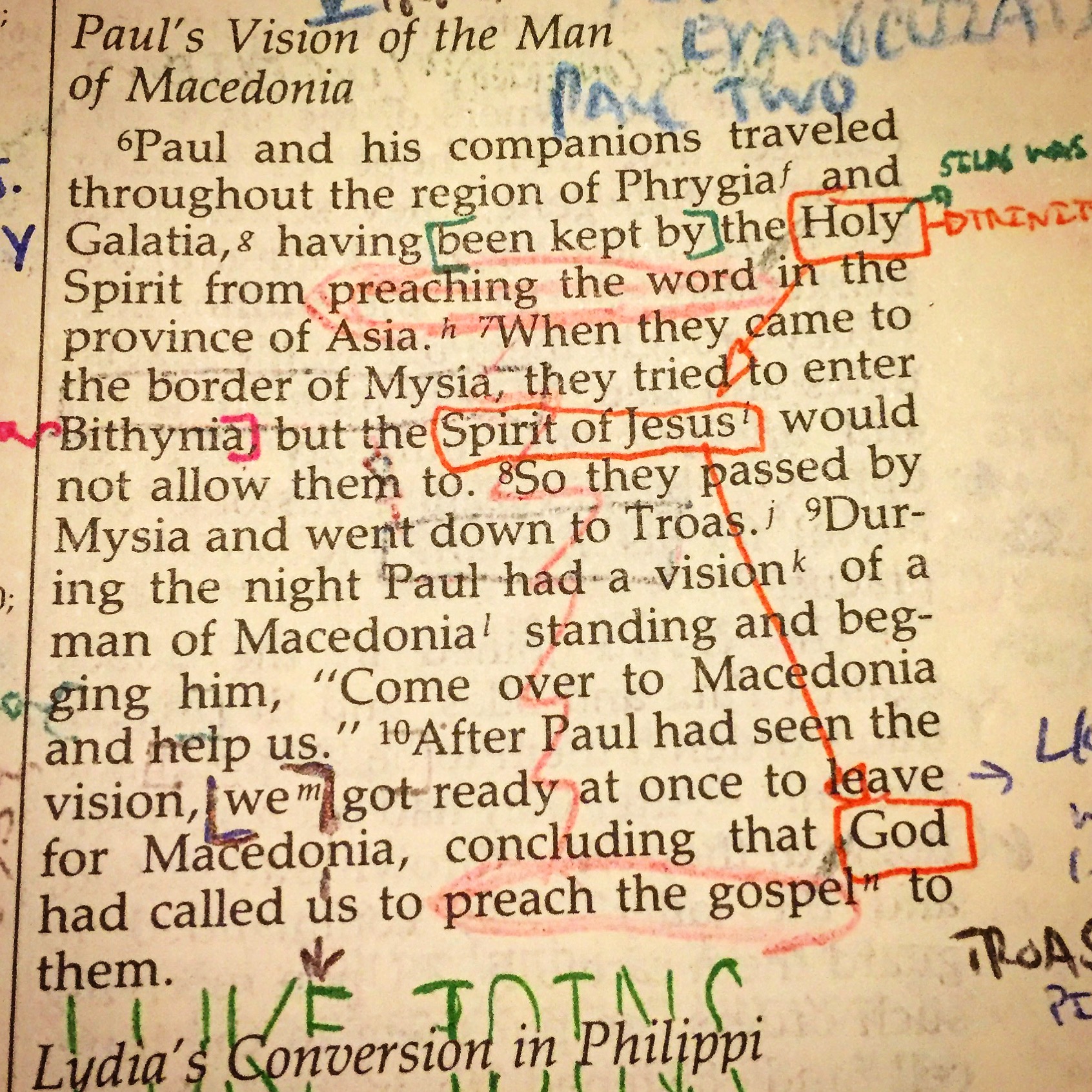
IMG_1697Most look at this passage of scripture and like to point out a connection between
— [Holy Spirit] v 6
— [Spirit of Jesus] v 7
— [God] v 10.
It’s definitely there, all three are present in guiding the movements of Paul and his companions; all three Persons of the Trinity working to spread the gospel according to their shared designs and plans.

This is not just conceptual work. It is actual work specifically carried out in specific places in the world: Phrygia, Galatia, Bithynia, Troas, Macedonia. That is the real story of the book of Acts—the work of Jesus, Son of and sent by the Father, continues in the world through the Holy Spirit. If Jesus tarries for another thousand years, the Father will have been just as gracious as if he had come a thousand years ago because the the Holy Spirit is presently and has always been carrying out the work of Christ in the world.

So what is He doing?

Right now while your are on your phone reading this, the Holy Trinity is working through regular folk just like you. Look at how this passage with all its references to the Trinity begins and ends with [preaching]. At first Paul is prevented from [preaching the word] in Asia by the Spirit, and prevented from preaching in Mysia by the Spirit of Jesus, until he is called to [preach the gospel] in Macedonia by God. The work of the Trinity in the world is to announce the gospel and the proclaim word of God through those willing to declare it… and to those willing to hear it.

For reasons known only to God. The gospel was prevented from being brought to the people of Mysia and Asia (at that time). Paul instead preaches the gospel to Macedonia for reasons that are clear. He is given a vision of a [man] calling for him to come to Macedonia and help. God is clearly the conductor orchestrating these events, and clearly Paul and his companions and the [man] of Macedonia are the instruments He is playing in a symphony of hearts brought to repentance and faith, praising His glorious and continuous presence in our world.

progressive revelation

IMG_1693The OT was revealed by Yahweh to Moses and the Prophets [and editors, scribes, compilers, redactors, etc. but you get my point]. After the appearance of the Messiah the NT becomes a exposition and expansion and explanation of that SAME revelation as it is seen through the lens of Christ.
That is progressive revelation… God does not reveal different or even more of himself, but what he has revealed is further and further nuanced and the resolution made sharper. That SAME revelation is all there (symbolically? inchoate?) even in Genesis 1:1. That verse doesn’t say anything specifically about propitiation or a divine council or eschatology, but painted with broad strokes it’s all in there. In beginning, there is One God, creator of all things. If he is the one creator of all, it makes sense that only that One could satisfy any debt—propitiation. If One God creates, all other gods are inferior—divine council. If all things begin with one God’s creative action, all things must also end with that One and the same God’s actions—eschatology. So, yes, on the one hand I’m reading a lot into one verse, practicing eisegesis, maybe seeing things that aren’t really there… on the other hand every step forward through the rest of the Old Testament and then into the New continues to align with everything that has gone before. Each step aligning or dovetailing with what has been continually said and done from the beginning.
Even today, we can say, the progressive revelation of Yahweh in the Old and Christ in the New Testament does not cease with the closing of the canon, but continues to be written into the life of the Church, through the power of the Holy Spirit. The Spirit continues to progressively reveal—bring into clearer focus and sharper resolution—that One and SAME revelation of God that was there even in the beginning.